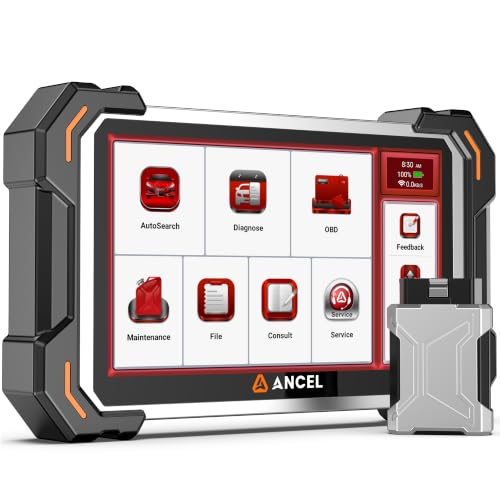

Imagine you are a mechanic facing a modern vehicle with a mysterious electrical fault. The check engine light is on, but a basic code reader only gives you a generic code. You need to dig deeper, to command components directly and validate your diagnosis. That is where the Autel MaxiCheck MX900 comes in. This review covers the MX900 and its close relative, the MX808S, to help you decide which bidirectional scan tool fits your workshop or garage for 2026.
We have spent time evaluating these tools, focusing on real-world performance, ease of use, and the specific features that matter most for diagnosing and repairing today’s cars. Whether you are a seasoned professional or a dedicated DIYer, this guide will help you understand what the MaxiCheck MX900 offers and how it compares to other options on the market. For a broader look at Autel’s lineup, check out our guide on the best autel scanner for the money.



Buying Guide
Bidirectional Control Capability
Not all scan tools are created equal. A basic code reader can only read and clear codes. A bidirectional scan tool, like the MX900, allows you to send commands to vehicle components. You can activate a fuel pump, cycle an injector, or run a cooling fan to verify it works. This capability is essential for pinpointing intermittent faults and avoiding unnecessary part replacements.
The MX900 boasts over 3000 bidirectional active tests, giving you extensive control over systems like engine, transmission, ABS, and body electronics. The MX808S also offers a robust set of active tests, making both tools powerful for diagnostic work. For a comparison with another professional tool, read our TOPDON AD600S review.
Vehicle Coverage and Protocol Support
Modern vehicles use advanced communication protocols like CAN FD and DoIP. The Autel MaxiCheck MX900 supports both, ensuring compatibility with newer models from GM, BMW, Volvo, and others. This forward-looking support is critical for a 2026 purchase, as it future-proofs your investment. The MX808S, while still capable, does not include these newer protocols, which may limit its use on late-model cars.
Both tools cover over 10,000 vehicles from 1996 onward, including US, Asian, and European makes. The MX900’s updated database and Auto VIN feature make vehicle identification faster, saving you time in the shop. For a look at a more basic option, see our innova 5610 OBD2 review.
Service Functions and Maintenance Capabilities
Daily repair work often requires special service functions like oil reset, brake bleeding, and throttle relearn. The MX900 excels here with over 40 maintenance services, covering 99% of common needs. This includes advanced functions like steering angle sensor calibration, battery registration, and injector coding. The MX808S offers 28+ services, which is still substantial but may lack some niche functions required for certain European or Asian vehicles.
Having these capabilities in a single tool reduces the need for multiple specialized devices, streamlining your workflow. If you are new to diagnostic tools, our article what OBD2 scanner should I buy can help you understand the options.
Hardware and User Experience
A scan tool’s performance depends on its hardware. The MX900 features a quad-core processor, 4GB of RAM, and 64GB of storage, running Android 11. This translates to fast boot times, smooth navigation, and quick data processing. Its 8-inch touchscreen with 1280×800 resolution is crisp and responsive, making live data graphs easy to read. The MX808S, while also fast, has a smaller 7-inch screen and less storage, but still delivers a solid user experience for its price.
Both tools are built for the shop environment, with durable cases and reliable wired connections. The MX900’s larger battery (7700mAh) is a bonus for extended use without needing a charge. For a comparison with another Autel model, read our autel MaxiCOM MK808Z-BT review.
Final Thoughts
Choosing between the Autel MaxiCheck MX900 and the MX808S comes down to your specific needs. For the professional mechanic who works on late-model vehicles with CAN FD and DoIP protocols, the Autel Scanner MaxiCheck MX900 is the clear choice, offering advanced protocol support, 40+ service functions, and a superior hardware experience. For the DIYer or shop on a budget who still needs powerful bidirectional controls and OE-level diagnostics, the Autel Scanner MaxiCheck MX808S provides excellent value without sacrificing core capabilities. Both tools are reliable investments that will elevate your diagnostic game in 2026.
Frequently Asked Questions
What is the difference between the Autel MaxiCheck MX900 and the MX808S?
The MX900 is the upgraded model with support for CAN FD and DoIP protocols, a larger 8-inch screen, more storage (4GB RAM / 64GB ROM), and over 40 service functions. The MX808S has a 7-inch screen, 4GB RAM / 64GB ROM, and 28+ service functions, but lacks the newer protocol support. Both offer over 3000 bidirectional active tests.
Does the Autel MaxiCheck MX900 work on BMW and Mercedes vehicles?
Yes, the MX900 covers BMW, Mercedes, and over 150 other makes. It supports DoIP for BMW E/F/G chassis models and provides full system diagnostics for Mercedes vehicles. Always check compatibility with your specific VIN before purchase, as service functions vary by model.
How often do I need to update the Autel MX900?
The MX900 comes with one year of free software updates. After that, you can purchase a subscription to continue receiving updates for new vehicle coverage and features. The tool will continue to work with existing functions even without an active subscription.
Can the Autel MX900 perform bidirectional tests on all systems?
Bidirectional tests are available for many systems, including engine, transmission, ABS, and body modules. However, not all vehicles or all systems support active tests. For a broader perspective on diagnostic tools, our guide what OBD2 scanner should I buy provides additional insights.