
You’re in the middle of a brake job, and you need to torque those caliper bolts to spec. Or maybe you’re swapping out spark plugs and want to avoid stripping the threads. A reliable torque wrench is the difference between a job done right and a costly mistake. This guide reviews the best torque wrenches for automotive work in 2026, covering options for both DIYers and professionals.
We’ve evaluated top models from trusted brands like EPAuto, LEXIVON, and Hairich to help you find the perfect tool for your garage. Whether you’re working on lug nuts, suspension components, or engine internals, we’ve got you covered. Read on to find the right torque wrench for your needs.



Buying Guide: What to Look for in a Torque Wrench
Choosing the right torque wrench can be overwhelming with so many options. Here are the key factors to consider before making your purchase.
Drive Size and Torque Range
The drive size determines the socket size you’ll use. For most automotive work, a 1/2-inch drive is ideal for lug nuts and suspension bolts, while a 3/8-inch drive is better for smaller fasteners like those on engine components. Consider the torque range you’ll need; most automotive tasks fall between 10 and 150 ft-lb.
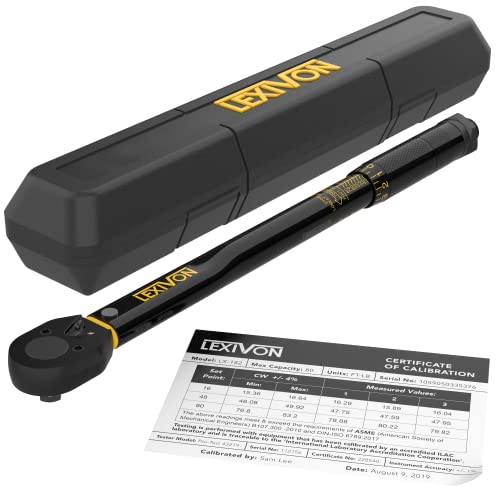
For example, the EPAuto 1/2-inch Drive Click Torque Wrench covers 10-150 ft-lb, making it versatile for most cars and trucks. If you work on motorcycles or smaller engines, a 3/8-inch drive like the LEXIVON 3/8-Inch Drive Click Torque Wrench 10~80 might be more suitable.
Accuracy and Calibration
Torque wrenches must be accurate to prevent over-tightening or under-tightening. Look for models that are pre-calibrated to a specific accuracy, typically ±3% or ±4%. Some come with a calibration certificate and a serial number for traceability, which is a mark of quality.
The Hairich torque wrench 1/2, 10-170ft.lb/13.6-230Nm boasts ±3% high precision, which is excellent for critical applications. The LEXIVON models also ship pre-calibrated to ±4% and include a certificate, giving you peace of mind.
Build Quality and Durability
A torque wrench is an investment, so you want one that will last. Look for models made from chrome vanadium steel, which offers strength and resistance to corrosion. A satin or electro-black finish can also protect against rust and wear.
The EPAuto and LEXIVON wrenches feature hardened chrome vanadium steel heads, while the Hairich model uses a chrome vanadium steel body with an aluminum titanium alloy handle. All are designed to withstand the rigors of a busy garage.
Ease of Use and Readability
You’ll be using this tool in tight spaces, so a clear, easy-to-read scale is crucial. Look for dual-range scales that show both ft-lb and Nm, and consider models with highlighted markings for low-light conditions. A comfortable, non-slip grip is also important for control.
The LEXIVON wrenches feature high-contrast yellow-on-black markings, and the Hairich has laser-printed dual scales. All have knurled handles for a secure grip. If you’re new to using torque wrenches, you might also want to check out our guide to the best torque wrenches for more tips.
Final Thoughts
After evaluating these top torque wrenches, we recommend the EPAuto 1/2-inch Drive Click Torque Wrench for its excellent balance of accuracy and value, making it perfect for most DIYers. For professionals who need a compact option for tighter spaces, the LEXIVON 3/8-Inch Drive Click Torque Wrench 10~80 is a reliable choice with its durable build and precise calibration. Whichever you choose, you’ll be investing in a tool that ensures your automotive projects are done safely and correctly.
Frequently Asked Questions
What size torque wrench do I need for my car?
For most passenger cars, a 1/2-inch drive with a range of 10-150 ft-lb is versatile enough for lug nuts, suspension bolts, and engine work. If you have a compact car or work on motorcycles, a 3/8-inch drive may be more suitable for smaller fasteners.
How often should I calibrate my torque wrench?
It’s recommended to calibrate your torque wrench every 12 months or after 5,000 cycles, whichever comes first. However, if you drop it or suspect it’s been damaged, have it checked immediately. Many models, like those from LEXIVON, come with a calibration certificate initially.
Can I use a torque wrench for reverse threads?
Yes, most click-type torque wrenches are bidirectional, meaning they can measure torque in both clockwise and counterclockwise directions. However, always check the manufacturer’s specifications, as some wrenches only measure in one direction. For example, the LEXIVON models measure torque in a clockwise direction only.
What is the difference between a click and beam torque wrench?
A click torque wrench emits an audible click when the preset torque is reached, while a beam torque wrench uses a pointer and scale to indicate torque. Click types are more popular for automotive work because they’re easier to use in tight spaces and provide a clear indication. For more insights, check out our best torque wrench article.