

You are torquing down the cylinder head on your sportbike, and you feel the bolt start to bind. Without a reliable torque wrench, you are guessing, and a guess can mean a stripped thread or a warped head. For any motorcycle owner, a precision torque wrench is not a luxury, it is a necessity. This guide covers the best torque wrench for motorcycles, from compact inch-pound models for delicate fairings to heavy-duty foot-pound wrenches for axle nuts and suspension components. We have evaluated six top contenders to help you find the perfect fit for your bike and your budget.
Whether you are a seasoned mechanic or a weekend DIYer, we have you covered. Our picks range from versatile multi-drive sets to specialized tools for specific tasks. If you are also working on bicycles, check out our guide to the best torque wrenches for bikes for more options. Let’s dive in and find the wrench that will keep your motorcycle running safely.



Buying Guide: What to Look for in a Motorcycle Torque Wrench
Torque Range and Drive Size
Motorcycles use a wide range of torque values. Small fasteners like engine case screws and handlebar clamps often need only 5 to 15 ft-lb, while axle nuts and large suspension bolts can require 80 to 150 ft-lb. A 1/4-inch drive wrench covers low-torque applications, while a 3/8-inch drive is the most versatile for general motorcycle work. A 1/2-inch drive is for heavy-duty tasks. Consider the specific jobs you will be doing most often and choose a range that covers them.
For example, the 1/4 3/8 1/2-inch Drive Click Torque Wrench set includes all three drive sizes, giving you a huge range from 10 in-lb to 180 ft-lb. This is ideal if you work on multiple bikes or want a single set for all your needs.
Accuracy and Calibration
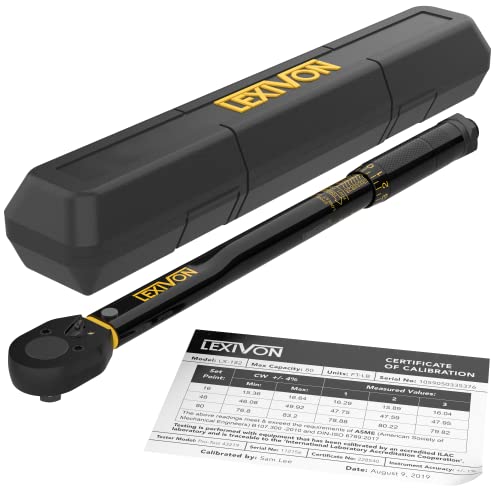
Accuracy is paramount. A wrench that is off by even a few percent can lead to over-tightening, which damages threads or gaskets, or under-tightening, which causes parts to loosen. Look for wrenches rated within +/- 3% or +/- 4% accuracy. Many quality wrenches come with a calibration certificate, which confirms they have been verified against a standard. The LEXIVON 3/8-Inch Drive Click Torque Wrench 10~80 ships pre-calibrated to +/- 4% and includes a certificate with a serial number, so you know it is ready to use out of the box.
For the most precise work, consider a model with a micro-adjustment feature, like the YIYEIE 50Pcs Master Bike Torque Wrench Set, which allows for 0.1 Nm adjustments. This level of control is excellent for carbon fiber components or small engine bolts.
Build Quality and Durability
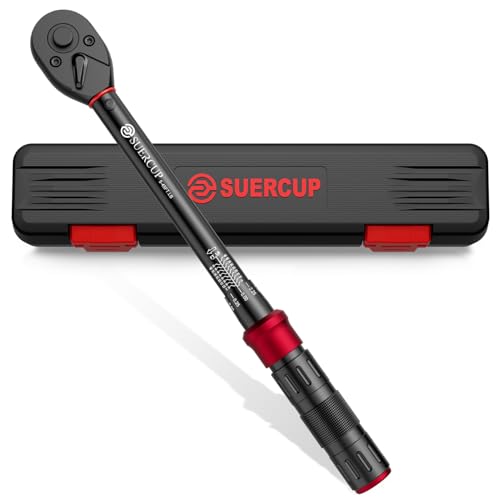
A torque wrench is a precision instrument, but it also needs to survive the garage environment. Look for wrenches with hardened steel ratchet heads and handles made from aluminum or steel. Corrosion resistance is also key, especially if you work in a humid climate. The LEXIVON Torque Wrench 1/2-Inch Drive Click 10~150 features an Electro-Black finish that offers excellent rust protection, while the SUERCUP 3/8″ Click Torque Wrench, 5-45 Ft.Lb uses a red anodized tail plug for added durability.
A comfortable, non-slip grip is also important, as it reduces hand fatigue during extended use. Many models feature knurled handles or ergonomic designs, like the HERONIX 3/8-Inch Drive Click Torque Wrench, which has an anti-slip handle for a secure hold.
Ease of Use and Readability
The whole point of a torque wrench is to give you a clear signal when the preset torque is reached. A loud, distinct “click” is essential, especially in noisy environments. Also, consider the scale: a dual-range scale (ft-lb and Nm) is convenient, and high-contrast markings make it easy to read in low light. The 1/4 3/8 1/2-inch Drive Click Torque Wrench set features a dual scale with micro-adjustments, and the HERONIX 3/8-Inch Drive Click Torque Wrench uses laser-etched scales that are easy to read in any lighting.
Quick-release buttons and reversible ratchets add to the convenience, allowing you to switch sockets and directions effortlessly. If you are new to using a torque wrench, check out our step-by-step guide on how to use a torque wrench for tips and best practices.
Final Thoughts
Choosing the best torque wrench for motorcycles comes down to your specific needs and budget. For a versatile all-rounder that covers most motorcycle maintenance tasks, the 1/4 3/8 1/2-inch Drive Click Torque Wrench set offers three wrenches in one, with excellent precision and a wide torque range. If you prefer a dedicated, high-quality 3/8-inch wrench for the most common jobs, the LEXIVON 3/8-Inch Drive Click Torque Wrench 10~80 is a reliable, budget-friendly choice that delivers consistent results. Whichever you choose, investing in a quality torque wrench is a smart move for any motorcycle owner.
Frequently Asked Questions
What is the best torque wrench for motorcycle use?
The best torque wrench for motorcycles depends on the tasks you perform. For general maintenance, a 3/8-inch drive click torque wrench with a range of 5-80 ft-lb is a versatile choice. For delicate work on small fasteners, a 1/4-inch drive wrench is better. Our top pick for overall versatility is the 1/4 3/8 1/2-inch Drive Click Torque Wrench set, which covers all ranges.
Can I use a regular torque wrench on my motorcycle?
Yes, you can use a standard automotive torque wrench on your motorcycle, but you need to ensure the torque range is appropriate. Many motorcycle fasteners require lower torque values than cars, so a wrench with a lower range is often more accurate. Using a 1/2-inch drive wrench on small bolts can be overkill and risk over-tightening.
How do I know what torque to use for my motorcycle?
Always refer to your motorcycle’s service manual for the exact torque specifications for each fastener. If you do not have a manual, many manufacturers provide specifications online. Using the correct torque is critical for safety and to prevent damage. For more tips, see our guide on using a torque wrench.
What is the difference between a click and beam torque wrench?
A click torque wrench emits an audible click when the preset torque is reached, while a beam wrench uses a needle and scale to indicate torque. Click wrenches are more precise and easier to use in tight spaces. Beam wrenches are less expensive but require you to watch the gauge while tightening. For motorcycles, a click wrench is generally preferred.


